Sucking in. Abdominal bracing. Stomach gripping. The subconscious pattern with many names.
When did I start seeing evidence beyond myself?
Sitting in every waiting room I’ve ever been in. In children forced to spend their days slumped down in cold metal school desks where their spines curl uncomfortably inward for their formative years. In how plenty of us grew up shamed and humiliated for being children, told by the world we'll only be loved if we're skinnier and smaller and better behaved. In the people walking around — twelve, twenty, sixty, eighty years old — who have spent every day of their lives sucking in their stomachs without knowing they're doing it. In every made up societal structure we’re forced to navigate and fight for survival in, dragging ourselves to work and back even when we’re sick and exhausted.
We are all running around scared and cut off from our bodies. And almost nobody is talking about what that actually does.
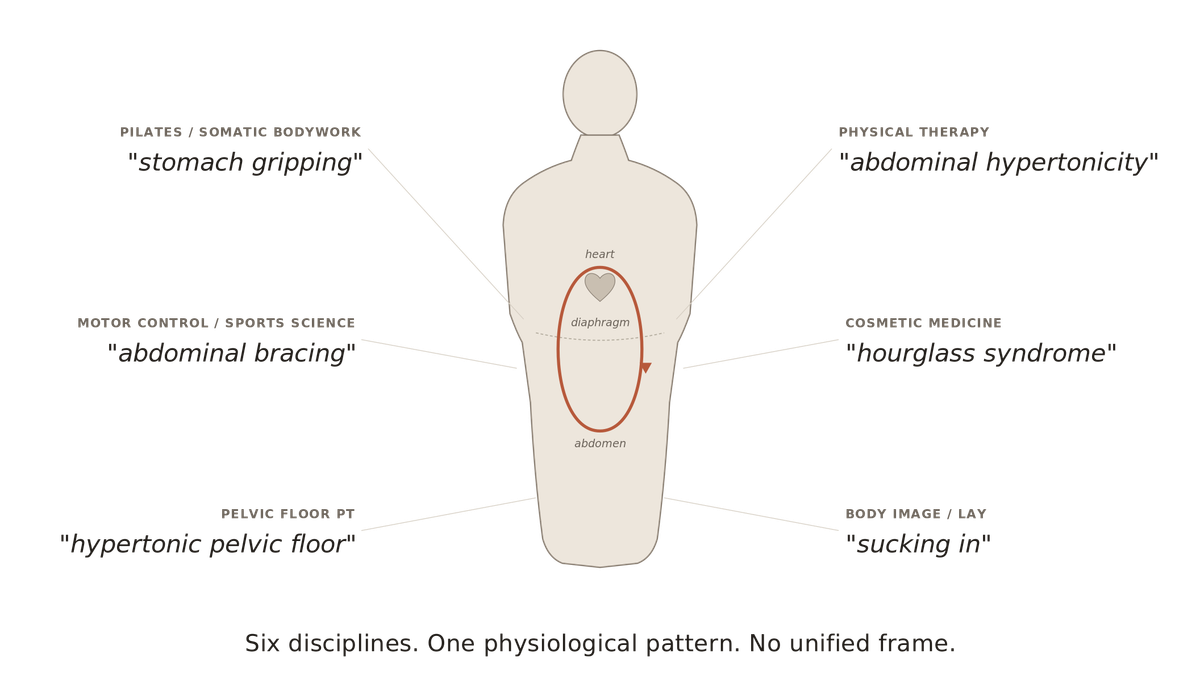
The pattern itself isn’t new. It has been observed across at least six clinical and lay disciplines, each looking at it through their own lens.
Physical therapy calls it abdominal hypertonicity. Motor control researchers call it bracing. Pilates calls it stomach gripping. Pelvic floor specialists call it nonrelaxing pelvic floor. Cosmetic medicine names it hourglass syndrome. And most of us just call it sucking in.
None of these framings are wrong. They are partial though. Each of these names represent one face of the same upstream phenomenon, just viewed from a different perspective. What none of them name is the feedback loop that drives it and sustains it. That’s because none of them are instrumented to see across muscular activity, breathing pattern, and autonomic state at the same time. That gap is the hole I am trying to close.
There is no “mental health” in a chronically dysregulated state. There is only survival. You don’t feel healthy when you’re walking around with anxiety that feels like spiders scurrying through your veins while you’re running from a leopard at the same time. That’s a bone-deep kind of electricity, the kind you don’t get to put down or walk away from. It doesn’t shut off at night either. It follows you to bed and it’s there when you wake up in the morning, exhausted from another night of tossing and turning.
For a subset of the population, most of what mainstream mental health treats as cognitive — negative thoughts, feelings, beliefs, rumination patterns — are, the framework proposes, often downstream of a nervous system locked in defensive activation. You cannot think your way out of a body that is running continuous threat surveillance. The thoughts are the weather. The state is the climate.
I lived inside this loop for 33 years before realizing I was stuck in it.
Therapists, doctors, neurologists, MRIs. Two graduate degrees in counseling from the University of Pennsylvania. U.S. Army service as an airborne combat medic. None of them brought my attention to the pattern in my body that was ruling my life.
When I finally caught it, I learned the tougher lesson: seeing the pattern is step one. The pattern doesn’t release on insight. It releases with conscious practice.
Initially, my lower back and body were so tense and locked up that I had to physically stretch before I could take a single full diaphragmatic breath. And the moment my attention shifted, the bracing came back.
That is the real shape of this problem. It is not just a visibility gap. It is a persistence gap. The nervous system holds the pattern, and the nervous system doesn’t unlearn it on command. Unlearning it is a marathon.
That framework — the one that started as 33 years of increasingly fascinating observation — is now publicly archived.
A preprint titled Chronic Abdominal–Pelvic Bracing as a Candidate Peripheral Perpetuation Mechanism in Autonomic Dysregulation, deposited at Zenodo: 10.5281/zenodo.20237464. It proposes a four-link physiological loop and seven falsifiable predictions for testing whether the loop holds together as proposed. The U.S. provisional patent on the device that would make the framework empirically testable was filed last week. The framework can now be discussed publicly. The device's specific architecture remains protected pending utility patent filing within the next twelve months.
Most human beings on Earth are shoved into a “socially acceptable” behavioral box from the day they are born. It is not inherently natural for a child to sit still and follow instructions for several hours a day. They learn that their worth depends on their ability to do it anyway, to the point of being yelled at, scolded, or humiliated for not getting it right. So their bodies only ever learn those types of rules. And their bodies stay stuck in those patterns.
The adult body that a twenty-five-year-old inherits after consecutive years of desk sitting is not a neutral baseline. It is already posturally-adapted to a seated-slouched arrangement. Lumbar curves compressed. Hip flexors shortened. Pelvis rotated backward. Forward head. The body was being conditioned for chronic tension long before most people had the ability to notice.
I am Kace Lagun. Independent researcher in Burlington, Vermont. M.S.Ed. and M.Phil.Ed. in Counseling and Mental Health Services / Professional Counseling from the University of Pennsylvania. B.S. Health Sciences, Drexel. U.S. Army Veteran. For several years I have been building the framework above — how chronic body-held tension is established, what it does once it’s there, and how it might be released deliberately rather than collapsed through crisis. In the last year that work produced a wearable device called Soften™, now in early prototype. The hypothesis and the device are being developed together; neither stands without the other.
The Chronic Bracing Lab is going to be a working document.
Some posts will be observational: things I have noticed in my own body and in the bodies I have seen in waiting rooms, classrooms, grocery store checkouts, public transit, and everywhere else. Some will be discussions of adjacent work, along the lines of somatic psychology, interoception, predictive processing, developmental trauma, and how these impact the body. Some will be about the experience of building and researching something from outside the university, with limited resources and a strict publication gate.
I am writing this for the readers I hope will find me soon: researchers and clinicians who take the body seriously; engineers who have built consumer hardware and are curious about measurement of soft physiological signals; mission-aligned funders in health tech; physical therapists, pelvic floor specialists, somatic practitioners, manual therapists; and anyone who has tried to meditate or therapize their way out of chronic tension and felt like it never quite reached the body itself.
The cadence here will be irregular but substantive. I would rather write one piece a month that is worth your time than four pieces that are not. If something I write here lands for you, please reach out.
There is another side of being alive that some people have never experienced. A version where the tension in the body has let go, the nagging sense of urgency fades, the jaw unclenches, the breathing comes easier, and the world’s harshness turns down by a noticeable amount. I was on the other side of it my whole life and didn’t know it.
The evidence is everywhere. I am starting here to make it visible.
— Kace
The Chronic Bracing Lab is written by Kace Lagun. Soften™ is a project in development. U.S. provisional patent filed May 2026. Preprint of the framework: 10.5281/zenodo.20237464.
Comments ()